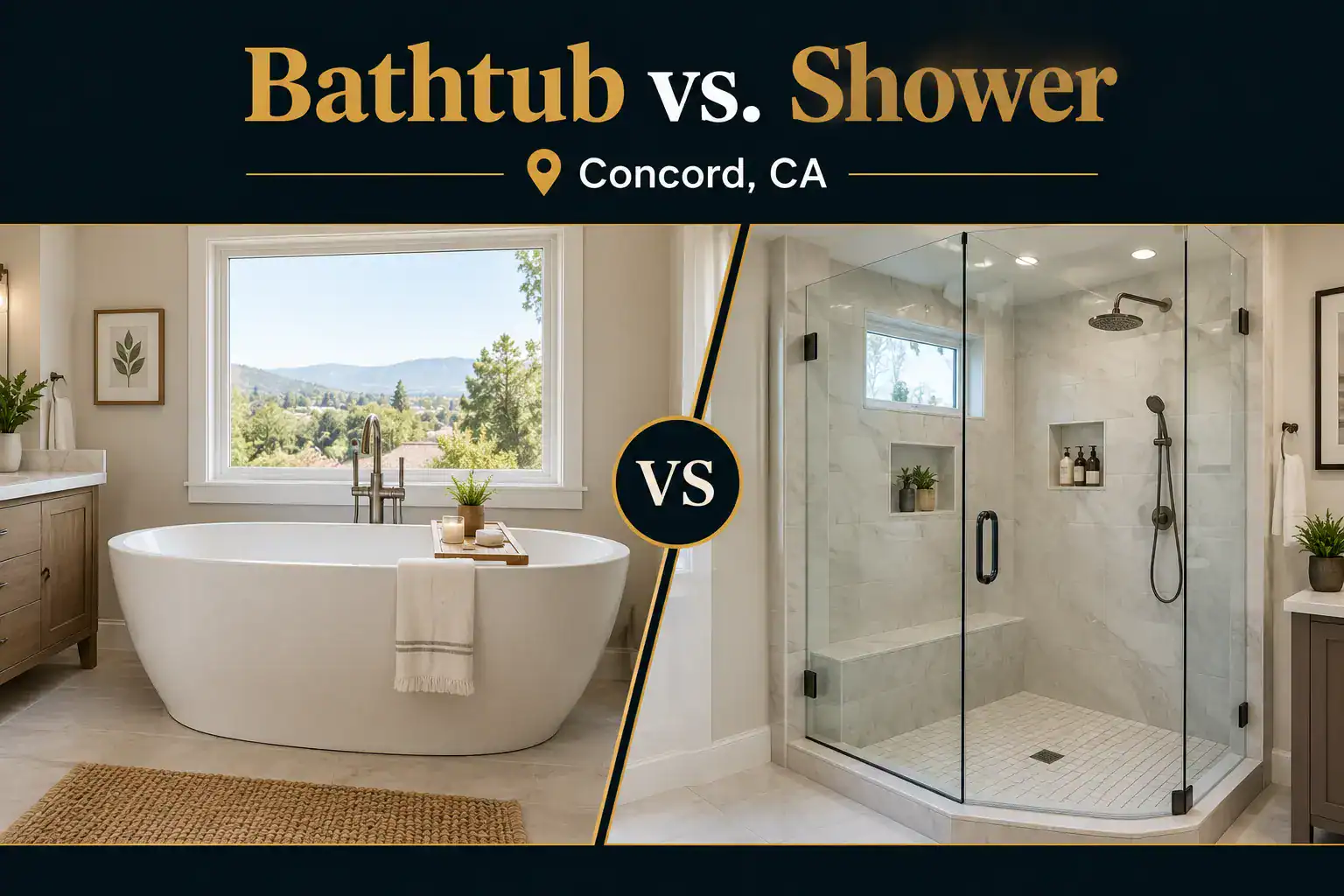
Bathtub vs. Shower: Which Is Right for Your Concord, CA Bathroom?
If you’re planning a bathroom remodel Concord, CA , there’s a good chance you’ve gone back and forth on this one already. Do you keep the tub, or finally rip it out for the walk-in shower you’ve been picturing? It’s one of the most common questions we hear from Concord homeowners, and honestly, there’s no single right answer. it depends on your bathroom, your household, and what you’re planning to do with the home down the road.
Here’s how to actually think through the decision, instead of just guessing.
The Quick Comparison
| Bathtub | Walk-In Shower | |
|---|---|---|
| Typical space needed | ~13 sq ft | ~9 sq ft |
| Installation cost | Similar or slightly less for a standard tub | Similar or slightly more, especially with tile and glass |
| Water usage | More per use (30–50 gallons for a bath) | Less per use (10–25 gallons for a typical shower) |
| Accessibility | Harder to step over, riskier for aging in place | Easier and safer access, especially with a curbless entry |
| Resale appeal | Still expected by many families and appraisers | Increasingly preferred, especially in primary suites |
| Daily practicality | Better for bathing kids or pets | Faster, more convenient for everyday use |
That table gives you the shape of the decision but the details matter more than the averages, so let’s get into it.
Does Removing Your Only Tub Hurt Resale Value?
This is the question that stops most homeowners in their tracks, and for good reason. it’s the one part of this decision that’s hard to undo later.
Here’s what the data actually shows: if your home only has one full bathroom, removing the tub is genuinely risky from a resale standpoint. Families with young kids, in particular, still look for at least one bathtub, and appraisers tend to factor that in too. Real estate research consistently backs this up buyers rank the number and type of bathrooms as one of their top considerations when evaluating a home, and a sizable majority of buyers say having both a tub and a shower somewhere in the home matters to them.
But if you have more than one bathroom, the calculus changes completely. The strategy that seems to work best for resale in 2026 is keeping a tub in at least one bathroom (usually the hall or guest bath) while converting your primary bathroom to a walk-in shower. That combination checks the box for families who need a tub somewhere, while still giving you the modern, spa-like primary bathroom that’s become one of the most requested upgrades we see.
if this is your only bathroom, think twice before removing the tub even if you personally never use it. If you have a second bathroom, converting your primary bath to a shower is one of the safer high-impact upgrades you can make.
What About Cost?
Cost alone usually isn’t the deciding factor here, but it’s worth knowing where the money actually goes, since the difference is bigger than most homeowners expect.
| Project | Estimated Cost (Concord, CA) |
|---|---|
| Standard tub replacement (same footprint, same drain location) | $3,000 – $8,000 |
| Prefab walk-in shower (acrylic/fiberglass kit) | $7,000 – $12,000 |
| Custom tile walk-in shower, framed or frameless glass | $12,000 – $18,000 |
| Full tub-to-shower conversion (demo + plumbing + new shower) | $7,000 – $20,000 |
A straightforward tub replacement same size, same spot, no layout changes is consistently the cheapest option, largely because there’s no demolition beyond removing the old unit and no plumbing rework involved.
A walk-in shower costs about the same or somewhat more, and the range depends heavily on two things: whether you go with a prefabricated kit or custom tile, and whether you choose framed or frameless glass. Prefab kits keep costs closer to a bath tub replacement’s price point; custom tile with frameless glass is what pushes a shower toward the higher end.
Where the cost really jumps is a full tub-to-shower conversion removing an existing tub and building a shower in its place. This involves demolition, moving or adjusting the drain and shower valve, and waterproofing the new space, all of which a simple swap doesn’t require. If you’re weighing a straight replacement versus a full conversion, our dedicated guide on tub-to-shower conversion costs breaks down exactly where that extra cost comes from.
One cost factor people often miss: if the drain location needs to move common when going from a tub’s centered drain to a shower’s corner or linear drain — that alone can add $1,500 to $4,000, regardless of which fixture you’re installing. It’s one of the first things worth asking a contractor to check before you commit to a budget.
Space, Water Use, and Everyday Practicality
Beyond cost and resale, there are a few practical differences that matter for how you’ll actually live in the space day to day.
Space: A standard shower needs less floor space than a standard tub — roughly 9 square feet versus 13. In a smaller Concord bathroom, that difference can be the thing that lets you also fit a larger vanity or better storage.
Water usage: Showers generally use less water per use than a full bath, especially with a modern low-flow showerhead. If water efficiency matters to you — or you’re trying to keep utility bills down — that’s a point in the shower’s favor.
Accessibility: This one matters more than people expect until they’re the ones dealing with it. Stepping over a tub wall gets harder with age, joint issues, or after surgery, and it’s a real fall risk. A curbless or low-threshold walk-in shower removes that problem entirely, which is part of why so many homeowners planning to stay in their home long-term choose showers even when resale isn’t the primary concern.
Daily use: If you regularly bathe young kids or pets, a tub is genuinely more practical there’s no substitute for being able to fill it with a few inches of water. If your household is mostly adults and mornings are about speed, a shower usually wins on convenience.
When a Tub Still Makes Sense
Despite the shift toward showers, there are a few situations where keeping (or even adding) a tub is the smarter call:
- You have young children or plan to in the next several years
- This is your only full bathroom
- You’re in a family-oriented neighborhood where comparable home listings typically include a tub
- You genuinely enjoy baths and use it regularly — this is your home, not just an investment
When a Walk-In Shower Makes More Sense
- You already have a tub in another bathroom
- The bathroom in question is your primary suite
- Accessibility or aging-in-place is a consideration, now or in the next decade
- The current tub is rarely or never used
- You want a more modern, open feel in a smaller bathroom
The Approach Most Concord Homeowners Are Landing On
If we’re being honest about what we’re seeing in actual projects, most homeowners aren’t picking one fixture across the board they’re mixing it up by bathroom. A walk-in shower goes into the primary suite, where it’s used daily and resale buyers increasingly expect it. A tub stays in the hall or guest bathroom, protecting the home’s overall resale flexibility without giving up the modern feel where it matters most.
If you’re only remodeling one bathroom and it happens to be your only one, that’s exactly when this decision deserves a longer conversation not just about what looks good, but about how long you plan to stay in the home and who else might live there or view it someday.
Not Sure Which One Fits Your Bathroom?
This decision really does depend on your specific bathroom, your household, and your plans for the home — which is exactly the kind of thing that’s easier to figure out with someone standing in the space with you.
Contact us today for a free consultation. We’ll walk through your options and help you land on the choice that actually fits your home, not just the current trend.
Frequently Asked Questions
Is it a bad idea to remove the only bathtub in a house?
It can be, especially if the home is likely to attract families with young children. If it’s your only bathroom, most real estate professionals recommend keeping some form of tub, even if you also add a shower.
Do walk-in showers really add more resale value than tubs?
It depends on context. In a primary suite where the home has another bathroom with a tub, a walk-in shower is a strong, well-received upgrade. As a total tub replacement in a one-bathroom home, it’s a riskier move.
Can I have both a tub and a separate shower in the same bathroom?
Yes, if the bathroom has the space for it — this is common in primary suites and tends to be well-received by buyers, though it’s a bigger investment than choosing one or the other.
Is a walk-in shower easier to keep clean than a tub?
Generally, yes, especially with a curbless design and larger tile or slab surfaces, which have fewer seams and corners than a tub surround. That said, glass enclosures do require regular squeegeeing to avoid water spots and buildup.
What if I'm not sure whether I'll want a tub again in the future?
If there’s any uncertainty and the space allows for it, a shower with the plumbing capped in a way that could support a future tub reinstall gives you flexibility — worth discussing with your contractor if you want to keep that option open.