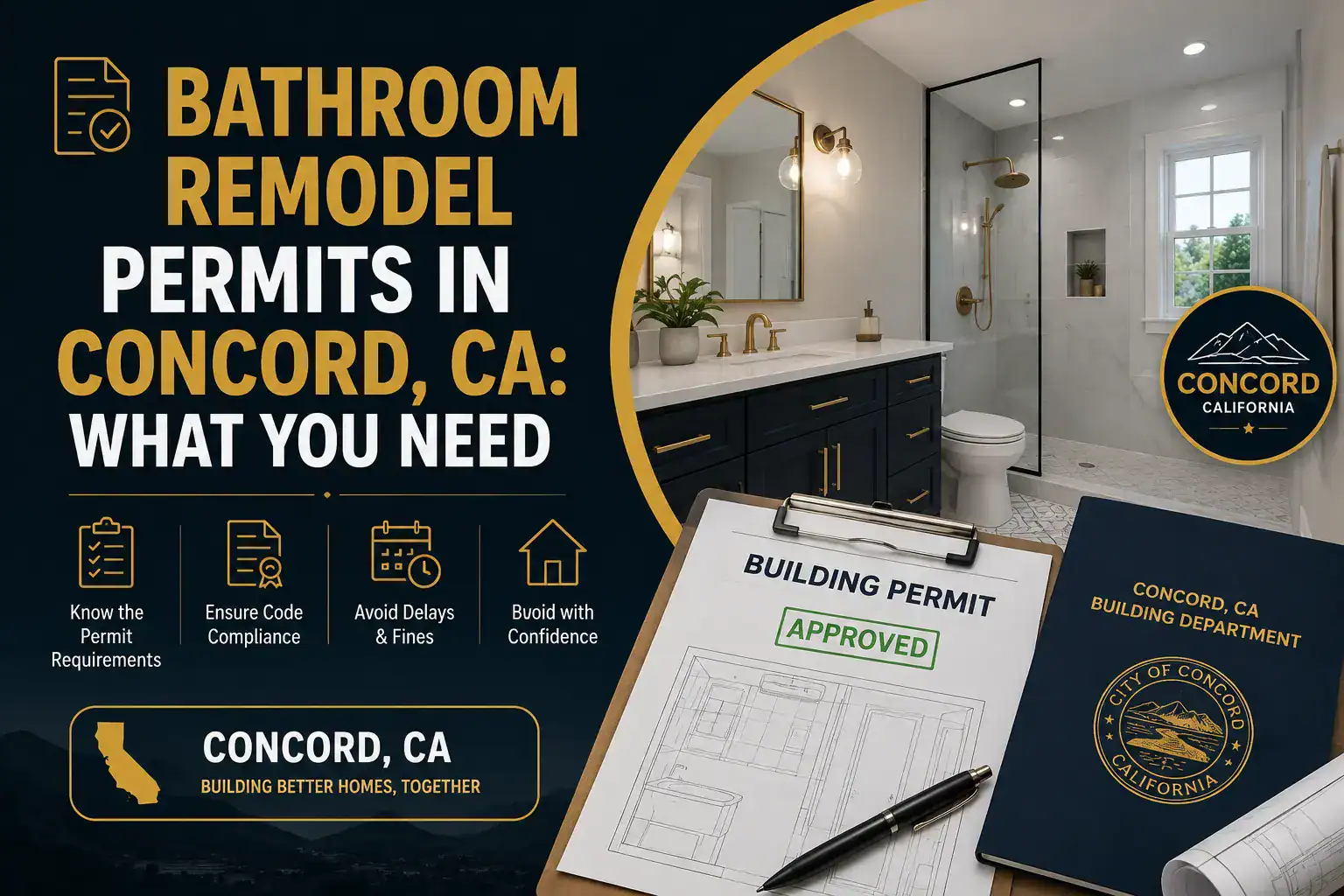
Bathroom Remodel Permits in Concord, CA: What You Actually Need
Planning a bathroom remodel in Concord? Before you tear out that old vanity or rip up the shower tile, there’s one question worth answering first: do you need a permit for this? The short answer for most real remodels is yes — but the details depend on exactly what you’re changing. Here’s a clear breakdown of what Concord requires, why it matters, and how to avoid the headaches that come with skipping the paperwork.
Do You Need a Permit for a Bathroom Remodel in Concord?
Not every bathroom project triggers a permit. Purely cosmetic work — repainting, swapping out a mirror or towel bar, replacing flooring, or installing a new faucet in the same location — is generally considered maintenance and doesn’t require city sign-off.
Once your project starts touching the systems behind the walls, though, the rules change. In Concord, a permit is typically required when your remodel involves:
- Plumbing changes — relocating a toilet, tub, shower, or sink, or adding new supply and drain lines
- Electrical work — new outlets, lighting circuits, or GFCI protection upgrades
- Structural changes — moving or removing walls, enlarging a window, or altering framing
- Ventilation upgrades — installing or relocating an exhaust fan
- Multiple fixture replacements — many jurisdictions in the Bay Area, including Concord, treat a “full” bathroom remodel (two or more fixtures or trades updated at once) as permit-triggering even if each individual item might otherwise be minor
If your project checks any of these boxes, plan on pulling at least a building permit, and likely companion plumbing, electrical, or mechanical permits as well.
How to Get a Bathroom Remodel Permit in Concord: Step-by-Step Process
Concord handles all permitting through its Building Division at the Permit Center (1950 Parkside Drive, Building D). Here’s exactly how the process works, from figuring out what you need to closing out your final inspection.
Step 1: Check Your Scope with Permit Pal
Before you apply for anything, use the city’s free Permit Pal tool. Enter your address and describe the work, and it will tell you which permits your project triggers (building, plumbing, electrical, mechanical) along with a preliminary fee estimate. This step saves you from applying for the wrong permit type or missing one entirely.
Step 2: Prepare Your Application Documents
For most bathroom remodels, you’ll need:
- A completed building permit application
- A simple plan or sketch showing the existing and proposed layout (required if you’re moving fixtures, walls, or adding circuits)
- Contractor license information, if you’re hiring a licensed contractor
- Any manufacturer specs for items like exhaust fans or water heaters, if requested during review
Simple, non-structural remodels usually need far less documentation than projects involving layout changes or new walls.
Step 3: Submit Through the Virtual Permit Center
Concord accepts building, plumbing, electrical, and mechanical permit applications online through its Virtual Permit Center (an Accela-based portal). You create an account, upload your application and any plans, and submit electronically — no in-person visit required to get started.
Step 4: Pay the Application Fee
After you submit, the city sends payment instructions, typically within five business days. You can check the exact amount ahead of time using Permit Pal, since fees are based on project valuation and the number of trades involved.
Step 5: Plan Review
City staff review your submission for compliance with the California Building, Plumbing, Electrical, and Energy Codes. A simple fixture-and-finish bathroom remodel usually clears review quickly. Projects with structural changes, moved walls, or layout revisions take longer and may go through one or more correction cycles if the reviewer requests changes.
Step 6: Permit Issuance
Once your plans are approved, the permit is issued. Most complete applications are issued within about 60 calendar days, though straightforward residential bathroom remodels are often approved much faster than that maximum window.
Step 7: Schedule and Pass Inspections
As construction progresses, your contractor (or you, if owner-permitted) schedules inspections through the Virtual Permit Center or by calling 925-671-3330. Typical inspection points for a bathroom remodel include rough plumbing and electrical, framing (if walls were altered), and a final inspection once everything is complete. Have your permit card on site and make sure the person who did the work is present — inspectors won’t sign off otherwise, and a missed appointment can mean a re-inspection fee.
Step 8: Close Out the Permit
Once the final inspection passes, the permit is closed and the work is officially on record with the city — which matters later for insurance, resale, and disclosure purposes.
Note: If your remodel is part of a larger addition, or involves moving soil or work in the public right-of-way, you’ll also need separate permits from Concord’s Engineering Division. Flag this with your contractor early so it doesn’t hold up your building permit.
If you’re in unincorporated Contra Costa County (not the City of Concord proper), your permit goes through Contra Costa County’s Department of Conservation and Development, not Concord’s Building Division. The process is similar, but the portal, fee schedule, and contact numbers are different — check your address on the county’s site or Concord’s own boundary lookup if you’re unsure which jurisdiction you fall under.
Why Concord Requires These Permits
It’s not just red tape. Permits exist to make sure the work meets the California Building Code, California Plumbing Code, California Electrical Code, and California Energy Code — all of which govern things like GFCI placement, tempered glass near tubs and showers, exhaust fan capacity, and energy-efficient lighting. An inspector checks that the work was done safely and correctly before walls get closed up, which protects you from problems that are expensive — or dangerous — to discover later.
There are practical reasons to care too. Unpermitted work can complicate a home sale, cause issues with your homeowner’s insurance if something goes wrong, and in some cases require you to open up finished walls for a retroactive inspection. Cutting the permit step to save time upfront often costs more later.
What Concord's Bathroom Code Requirements Cover
Once a permit is pulled, your remodel needs to meet a set of specific technical requirements. A few of the most common ones homeowners run into:
- GFCI-protected outlets within 36 inches of the outside edge of each sink basin
- High-efficacy lighting that complies with the California Energy Code, with at least one fixture on a vacancy sensor
- Mechanical ventilation — a bath exhaust fan rated for a minimum of 50 CFM, vented to the outdoors, is required in every remodeled bathroom regardless of whether there’s a window
- Tempered safety glass at tub and shower doors, and at windows within 60 inches of a tub or shower drain
- Pressure-balancing valves on tub and shower controls, set to a maximum of 120°F, to prevent scalding
These aren’t optional add-ons — they’re baseline code requirements your contractor and inspector will both be checking for.
How the Permit Process Works in Concord
Concord handles permitting through its Building Division at the Permit Center (1950 Parkside Drive, Building D). Here’s the general path:
- Check your scope with Permit Pal. The city’s online Permit Pal tool helps you figure out which permits your specific project needs and gives a fee estimate before you apply.
- Submit your application online. Concord processes building, plumbing, electrical, and mechanical permits electronically through its Virtual Permit Center.
- Pay the application fee. After submittal, the city sends payment instructions, generally within five business days.
- Plan review. Staff review your submission for code compliance. Straightforward residential bathroom remodels typically move faster than commercial projects, though complex scopes can take a few review cycles.
- Permit issuance. Most complete applications are issued a permit within about 60 calendar days, though simple residential remodels are often much quicker.
- Inspections. As work progresses, your contractor schedules inspections (rough plumbing/electrical, framing, final) so the city can verify the work before it’s covered up.
If your remodel is part of a larger addition or involves moving soil or work in the public right-of-way, you may also need separate permits from Concord’s Engineering Division — that’s a good thing to flag with your contractor early.
What Permits Typically Cost
Fees vary based on the scope and valuation of your project and how many trades are involved. As a rough benchmark, a straightforward bathroom permit (fixture and finish updates, no structural work) typically runs $200–$800 in city fees, while a full remodel pulling building, plumbing, electrical, and mechanical permits together often lands in the $400–$1,200 range. Projects with structural changes, added square footage, or multiple correction cycles can run higher. For a standard residential bathroom remodel, expect a combination of:
- A base building permit fee tied to project valuation
- Separate plumbing, electrical, and mechanical permit fees if those trades are triggered
- An administrative/technology surcharge applied to the total
These are general estimates, not Concord-specific quotes — Concord’s Permit Pal tool gives the most accurate number for your specific project, since fees scale with scope rather than being a flat rate.
Skipping the Permit: Why It's Not Worth the Risk
It can be tempting to treat a bathroom remodel as a weekend DIY project and skip the paperwork, especially for smaller jobs. But if the work is ever discovered unpermitted — during a future sale, an insurance claim, or a neighbor complaint — Concord can require you to open up finished walls for inspection, and some fee schedules charge double or triple the normal permit cost for work started without one. A relatively minor project can turn into a much bigger, more expensive one.
If your Concord bathroom remodel involves moving plumbing, adding electrical circuits, changing ventilation, or touching structural elements, you’re almost certainly looking at a permit — and likely more than one. The process is manageable once you know the steps: confirm your scope with Permit Pal, submit through the Virtual Permit Center, pay your fees, get through plan review, and schedule inspections as the work happens.
Working with a licensed contractor familiar with Concord’s Building Division makes this whole process smoother — they’ll know what triggers a permit, what the inspector will be looking for, and how to keep your project moving without surprises.
Frequently Asked Questions
1. How much do bathroom remodel permits cost in Concord, CA?
Typically $200–$800 for a straightforward remodel, or $400–$1,200 when multiple trade permits (plumbing, electrical, mechanical) are combined. Use the city’s Permit Pal tool for an exact estimate.
2. Can I apply for a bathroom remodel permit in Concord online?
Yes. Applications for building, plumbing, electrical, and mechanical permits are submitted online through Concord’s Virtual Permit Center.
3. What is the Concord permit portal?
It’s the Virtual Permit Center (an Accela-based site) for submitting Building, Engineering, and Planning applications, plus checking status and scheduling inspections.
4. How do I search for a permit in Concord?
Look up permit status and history by address or permit number through the Virtual Permit Center, no account required.
5. Do you need a permit to remodel a bathroom in California?
Yes, if the work touches plumbing, electrical, structural, or ventilation systems. Cosmetic-only updates (paint, flooring, like-for-like fixture swaps) are usually exempt.
6. What can a homeowner do without a permit in California?
Cosmetic work: painting, flooring, cabinets/countertops (same layout), and like-for-like fixture swaps. Anything changing plumbing, wiring, or structure needs a permit.
7. Do I need a permit to add a room in my house in California?
Yes. Room additions require a building permit and must meet local zoning rules like setbacks and lot coverage.
8. How long does it take to get a bathroom remodel permit in Concord?
Simple residential remodels are often approved in days to a couple of weeks. The city’s official maximum is 60 calendar days for a complete application, with longer timelines for projects requiring structural review or correction cycles.